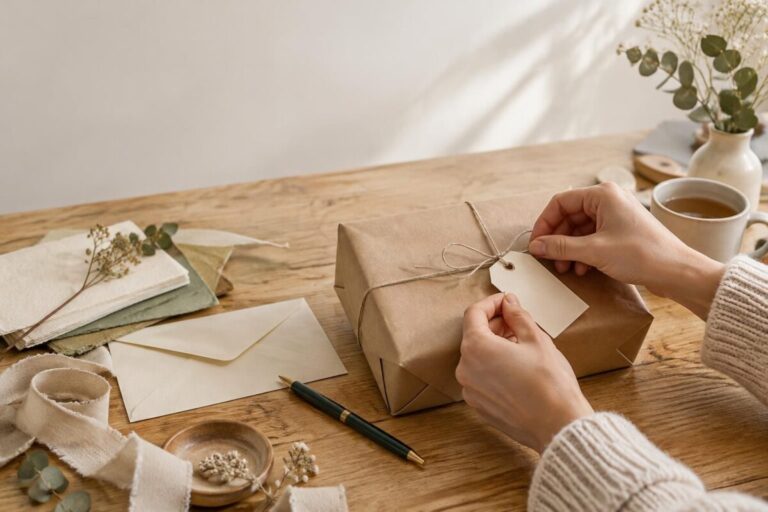
Creative stationery: too delicate, or perfect for making a statement?
Hello, Sophie here.
Yes, creative paper crafting can be delicate, but the right paper and careful mounting can turn it into a gift or decoration that really makes an impression.
For a special occasion, a few well-chosen details can transform a simple piece of paper into a treasured keepsake. The secret isn’t to choose the thickest paper, but the one that suits the project and how it will be used.
Good habits to adopt before you start creating
- Define how it will be used: a card, invitation, wall decoration, or notebook each calls for a different type of paper.
- Check the paper weight and the compatible techniques listed on the product page.
- Choose the texture based on the look you want: smooth for precise lines, textured to add dimension.
- Test the ink and glue on a scrap before starting your final project.
- Plan how to mount or store it to help your project last.
Before buying, a guide to creative stationery supplies can help you compare papers based on how they’ll be used. To learn more, the criteria for choosing the right stationery supplies can help you avoid disappointing purchases.
The pitfall: choosing thick paper for every project
A higher paper weight gives the impression of sturdiness, but that doesn’t make every type of paper versatile. For writing or taking notes, 70 to 90 gsm paper is often enough; an overly thick notebook can quickly become heavy without offering any real benefit.
For dry media drawing, paper around 120 gsm offers a good balance. 250 gsm paper is better suited to some wet techniques or projects that need more structure, but always check the manufacturer’s recommendations.
Another pitfall is relying solely on the “multi-technique” label. A smooth Bristol-style surface is ideal for details and inking, while more textured paper provides better grip for charcoal, pastels, or pencils.
Which paper should you choose for your project?
| Project | Paper to consider | What to watch out for |
|---|---|---|
| Note-taking | 70 to 90 gsm | Choose a format that’s easy to carry. |
| Sketching and pencils | About 120 gsm | Check the texture and how well it withstands erasing. |
| Card or decoration | About 200 to 300 gsm | Test folding, cutting, and gluing. |
| Alcohol markers | Paper designed for these inks | Check for bleed-through and use a protective sheet. |
Can decorative paper creations last without losing their charm?
Yes, if delicate paper is protected from creases, moisture, and overly aggressive mounting. For wall decorations, fairly rigid cardstock, a clean cut, and suitable adhesive often make more difference than choosing the thickest paper possible.
Imagine Camille, who’s making personalized cards and a small garland for a party. She tests her glue on a scrap, leaves each piece to dry flat, then hangs the garland using fasteners suited to the wall: the result stays light but won’t warp at the first draft.
Self-adhesive photo paper can also create a lovely effect, but its adhesive isn’t suitable for every surface. In particular, avoid wallpaper, freshly painted walls, skin, and electronic devices, and always test the adhesion in an inconspicuous spot.
Three steps to a polished, long-lasting creation
- Plan your project. Choose the format, paper, and technique before cutting. A handmade notebook that will be handled often has different needs from an invitation kept in an envelope.
- Make a test piece. Try folding, ink, and glue on a scrap. For a custom creation, this test also lets you adjust the colors and dimensions before making several copies.
- Assemble and protect. Apply a thin layer of glue, press gently while flat, and let it dry completely. Then store your creations away from moisture and direct light.
For a clean finish, a precision craft knife, metal ruler, and cutting mat are invaluable. A sharp blade prevents torn edges, while paper glue helps minimize marks and warping.
Binding and format matter, too
A4 gives you plenty of room to draw or organize sheets, but takes up more space in a bag. A5 is easier to carry and works well for daily notes or a notebook dedicated to a project.
Spiral binding opens flat easily, which is handy for drawing or writing without having to hold the pages down. For filing sheets, check the hole-punching and whether the pages are micro-perforated. Acid-free or pH-neutral paper can be a good choice for creations you want to keep for a long time.
High-end paper isn’t always essential: the best choice is the one that suits how you’ll use it. To help it last, store paper pads flat in a dry place and wait until the ink is completely dry before stacking or gluing the pages.
What paper weight should I choose for a sketchbook?
For pencil, pen, and sketches, 80 to 120 gsm is generally sufficient. If you use ink or erase often, thicker paper may be more comfortable.
Is an A5 notebook suitable for studying?
Yes, it’s easy to carry and can be dedicated to a subject or project. For large diagrams and sheets to file, A4 is often more practical.
How can I keep ink from bleeding through the paper?
Choose paper that’s compatible with your medium, protect the next page if needed, and test the ink first on a scrap or an inconspicuous page.
How should I store paper creations?
Store them flat, somewhere dry and away from direct light. A suitable folder or binder helps prevent creases and scuffs.
Thanks for reading! Feel free to share your thoughts in the comments. — Sophie